Willing to engage
Before passion, motivation and skill, it is the biology of willingness that determines whether we are ready as humans to engage, particularly when we are under pressure, says Iva Biondic in Upwilling


Don’t begin with talent, performance, motivation, strategy, leadership or even intelligence. Begin with willingness, because in a world obsessed with skills and outcomes, it has become the invisible missing foundation.
We are preoccupied with developing leadership competencies, agile methodologies, AI tools, coaching skills, feedback tools, purpose statements and, somewhat less often, emotional intelligence, resilience frameworks and collaborative technologies. Even so, engagement keeps thinning, trust keeps shrinking and burn-out keeps spreading.
Even when people have everything by way of competence, opportunity and options, something collapses internally and they simply cannot engage. Not because they do not know what to do. Not because they do not care. But because their system is no longer available.
You are not a brain dragging a body to meetings, dates, family meals, morning runs or pilates classes. You are one living system. Willingness is not just a concept. It is a physical state. You can feel it: the difference between openness and contraction, curiosity and defensiveness, presence and withdrawal. You can watch it happen in people, in teams, in real time. It is almost embarrassing how visible it is once you know what you are looking for.
It’s why so many modern development models go wrong. They are built as if the human being is primarily a cognitive machine: give people the right skills, the right incentives, the right tools and behaviour will follow.
But the human system does not work like that. Under pressure, we do not become more intelligent. We become more protective. We become smaller. We simplify. We cling to what is familiar. We reach for certainty. We revert to identity. This is not a defect. It is biology.

Willingness is the capacity to stay present, responsive and engaged, especially when conditions are imperfect. It is what allows us to remain in contact with reality long enough for choice to return. It is not simply what we want to do nor even what we believe in. It is whether we are internally available to engage at all. This is why willingness consistently outperforms passion, motivation and skill.
Passion burns hot and briefly. Motivation fluctuates with context, meaning and reward. Skill remains dormant when pressure, threat or incoherence take over. Willingness, by contrast, determines whether any of these can be expressed under real conditions. That is also why the question is not how to feel more inspired, but what helps us return to willingness when it does not come automatically.
Under pressure, the human system does not first ask what is right in principle. It asks something more immediate and more embodied: ‘can I stay in contact with this?’, ‘can I bear what engagement will require?’, ‘is there enough safety, coherence and energy here for me to remain available?’
Willingness lives at this threshold. It is not an idea and not an intention. It is a condition: the moment-to-moment state of the body-mind system that determines whether engagement is even possible. When the system is organised around coherence, engagement can be sustained even without certainty. When it is organised around threat, willingness erodes early, long before behaviour changes, long before performance drops and long before anyone names disengagement.
Willingness, understood properly, is the capacity to remain internally available despite this bias. It is the ability to stay open enough to choose an adequate response, simply to respond rather than react. It is what allows a person to listen when certainty would be easier, to try when outcomes are unclear and to remain present when withdrawal would feel safer. This is why willingness survives where passion does not. Passion depends on emotional intensity.
This is where upwilling diverges from familiar self-help framing. It is not an attitude. It is not a personality trait. It is not enthusiasm, positivity or the ability to hype yourself into performance. It is a psychosomatic condition, a lived state shaped by regulation, meaning, confidence and context. Mindset matters, yes, though only to the extent that the inner system is resourced enough to live it.
It is also why disengagement is so often misunderstood. When there is no upwilling it is usually a result of willingness fading before performance does. People may still comply. They may still execute. They may still deliver. Yet something has already changed inside: participation becomes mechanical, learning becomes defensive, responsibility becomes survival. This is where downwilling shows up in its most socially acceptable forms. People attend the meeting and withhold the truth. They produce output and withdraw initiative. They remain visibly busy while becoming inwardly absent. They stay loyal to the role while detaching from the work.
Willingness is not sustained by good intentions. It is sustained by capacities. Emotional intelligence enables you to read and hold emotion without becoming it. Cultural intelligence enables you to stay open across difference instead of shrinking into judgment. Positive intelligence enables you to regulate under load and recover from disruption. Conversational intelligence enables you to stay relationally available and generative in interaction. Collaborative intelligence extends into systems: shared agency, distributed responsibility, co-thinking without domination. These intelligences do not create willingness in theory. They make willingness livable in practice.
That is the deeper promise of upwilling. Not peak performance. Not permanent motivation. Not constant confidence. Something rarer: the ability to stay internally available to life as it is and still choose participation over protection. Willingness, unlike passion, does not require certainty. Unlike motivation, it does not depend on reward. Unlike skill, it does not disappear when conditions change. It is what allows effort to continue without exhaustion, learning to occur without fear and leadership to remain human rather than performative.
When willingness is present, skills become accessible. Intelligence becomes usable. Relationships remain alive. When it vanishes, no amount of passion, incentive or expertise can compensate for the loss of inner availability.
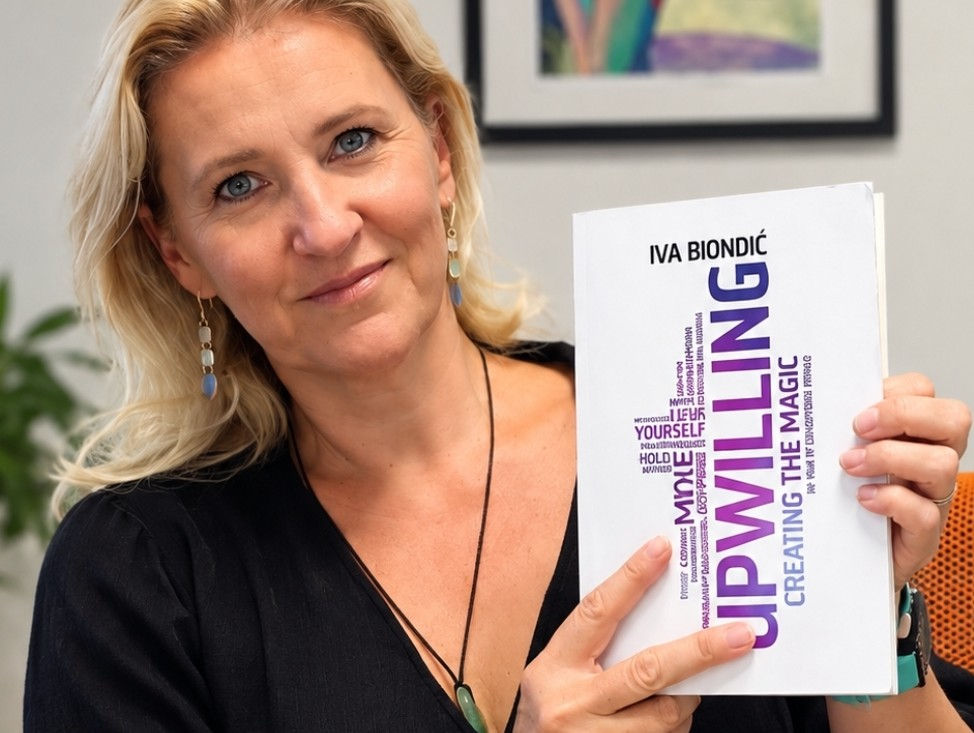
• 'Upwilling: The magic of we in uncertain times' by Iva Biondic, Novaro Publishing, September 2026, ISBN: 978-1-0685644-8-2. See here for details.