
Leadership for inspiration
- Jan 14
- 5 min read
Widely recognised as Europe's best zoo, breakthroughs in performance and conservation at Pairi Daiza rely on the inspiration to turn vision into reality

Eric Domb admits to being a leader by necessity. What he really is, he has discovered, is a yellow on the personality spectrum. He is inspired by bright visions and then expects all the organisation to fall into place. Other people, he has learned, are more interested in the details of taking it a step at a time.
Today his vision to bring animals and humans together in authentically beautiful, spiritually uplifting surroundings is regularly recognised as Europe’s best zoo. For him it’s not just about caring for the physical heath of the animals, but their psychological wellbeing as well.
His view is that there are three categories of animal: domestic, wild and those raised in captivity. ‘We care for the last of those with a wider view of supporting conservation in the wild.’
Over the last 30 years, he has built eight worlds around an old abbey in Belgium. Today, his zoo, Pairi Daisa, attracts two million visitors a year, employs 600 people, has revenues of €600 million and cares for 7000 animals.
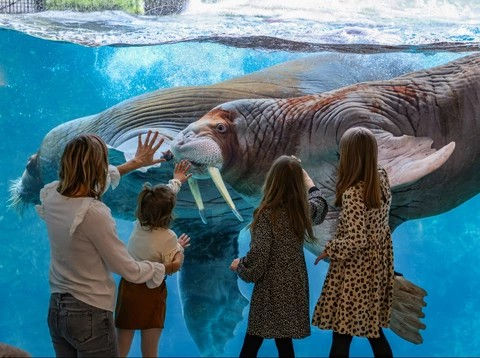
Each of his worlds faithfully recreates natural environments in which he seeks to bring animals and humans together with a shared sense of love. In the room where you can stay as a guest beneath the pool in his marine world, he takes pride in the curiosity that walruses and children share with each other.
No detail is spared in creating such moments. In his Asian world, for instance, the temple is built with original materials and in consultation with local tribes. In his new entrance hall, he has commissioned 96 mosaics from the leading modern exemplar of a Syrian traditional craft.
Ultimately, he would like to build four more worlds, starting with a spiritual Japanese garden. In starting to think about how to build it, he doesn’t consider how the numbers will stack up. Instead he takes inspiration from learning about each culture, before designing an experience that mutually enriches animals and humans.

It is a legacy he wants to continue. Eight years ago, the company came off the Belgian Stock Exchange, when a billionaire put aside his normal financial instincts to buy the outstanding 30 percent of shares. Domb holds the remaining 70 percent. Together they intend that the pioneering work at Pairi Daisa in bringing animals and humans together will continue long into the future.
‘Most of us love nature, we love animals. The challenge,’ says Domb, ‘is how can we translate the amazement we feel wandering through a zoo to love, compassion and then action for the brothers and sisters of animals who are suffering in the world.’
An unexpected path
So how has all this inspiration come together? How did Domb find himself in the position of running Europe’s most admired zoo? How can his vision be maintained amidst the realities of running what is becoming a large and complex operation? Now 62, how does Domb reflect on a path he never expected to take?
Find yourself
As a boy, Domb read adventure comics and wanted to be a surgeon, before following his father’s wishes and training as a lawyer. As a career, it didn’t live up to his sense of wanting to be useful to others. So he started advising smaller companies on realizing their plans.
Then by chance, he agreed to humour a colleague by accompanying her father-in-law to view an abbey that he was thinking of turning into a bird park. Domb was unconvinced, until he saw it. Together they resolved to launch a business, although each had different versions of it. In any case, the father-in-law left in a few weeks. However, at the age of 32, Domb had found his purpose. Or, perhaps more accurately, his purpose had found him.
‘I'm still a normal person. I have no particular skills for bringing a project to this level. It was something beyond, something that drew me, giving me strength from outside.’
Sustainable energy
His first step was to write a perfect business plan. None of it worked, Domb is now happy to admit. Instead, he relied on an incredible sense of energy that came from finding his life’s meaning: to share a love for beautiful nature with everybody.
‘This gathering was a kind of spiritual survival for me. When we started with 20 people, it was hell. Those are the heroes of such stories as ours, not those working comfortably on strategy.’
In his view, it’s a duty to make sure all those efforts become financially sustainable. ‘I didn't build a limited company, because I loved it. It was not a goal, it was a condition. And I became a leader by necessity, that's the truth.’
‘I had to incorporate the company, otherwise you will not find a banker. You have to structure it if you’re hiring people or signing contracts. It’s a condition of making yourself sustainable.’

Attracting talent
He has relied on attracting talented people to help him transform his ideas into reality, Even now, he says, it remains his toughest, but most rewarding challenge.
For the foundation he has created to support the conservation of wild animals, for instance, he recently persuaded the head of WWF (Worldwide Fund for Nature) in Belgium to join him, rather than accept a promotion to Switzerland. ‘Conservation is not just a dream here. We have a real energy to do something. That’s why we can attract such interesting people.’
Creative intensity
Domb has a clear conception of his role: to make these dreams visible. So, in creating the gardens at Pairi Daisa, he wants to give visitors a sense of the colours of paradise. His gardeners had their doubts. How could new blooms happen every two weeks?
‘If you don't push people to go beyond what they think they are capable of, they will not evolve as far as they could. They’re able to do it all, even though they don’t know it yet.’
He brings the same intensity to creating new worlds. First, he takes a trip and brings back lots of photographs. His architects and designers then interpret these through trial and error.
‘It’s all done in-house, which is what makes it so unique. Our discussions are not always pleasant, because we are talking about something that matters. It's not just about making money, it's about making something beautiful. We have some strong personalities, so it can be painful. I need to remind them of our real vision: the love between humans and animals.’
Organisational efficiency
As a leader, says Domb, you should be aiming to become as useless as possible, where your inputs are totally unnecessary. ‘You want to reach the stage when you know, the organisation can survive. Like your children, you love them, but you want them to become autonomous, so they can overcome big challenges, big crises.’
‘In an efficient organisation, you will have a clear vision, as well as people who can turn it into reality. At the beginning, I was running from one place to the other. Now it’s much easier and I can spend the first half of each month in Spain with my wife.’
• Eric Domb and the story of Pairi Daiza appear in a chapter on 'Leadership for Inspiration' in 'What Leadership is For', a book by Patrick Faniel, chief executive of Management Centre Europe, published by Novaro, February 2024, ISBN: 978-1-7398640-7-1. See details here.


